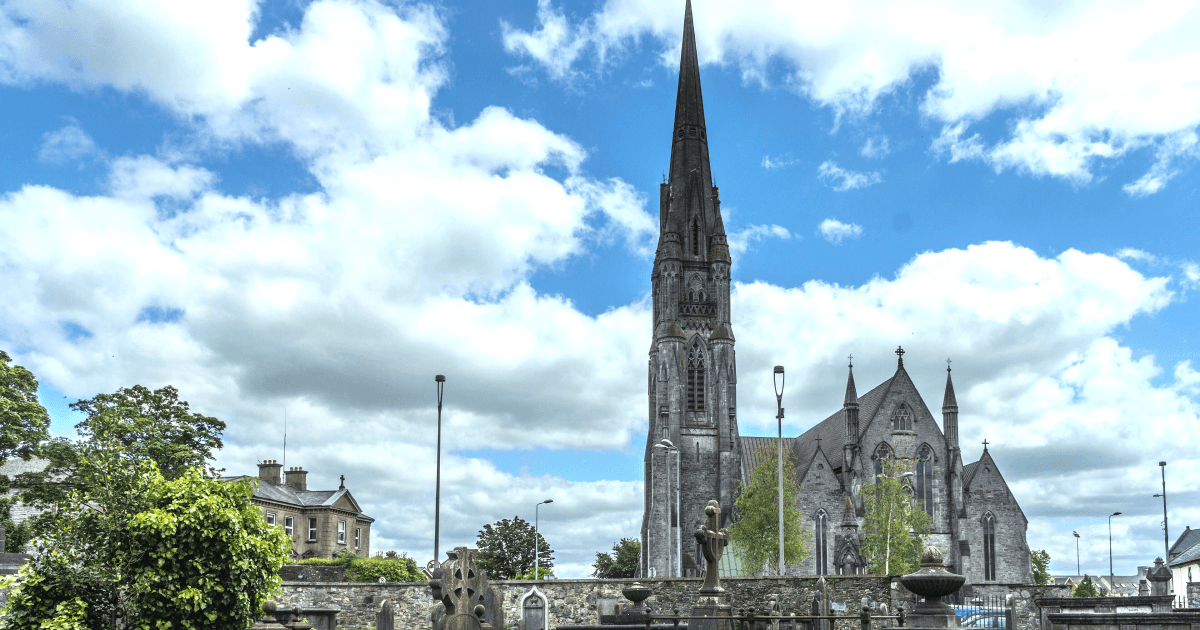
While many have written off the Catholic Church in Ireland, there are signs of life in the old dog yet, as the Archdiocese of Dublin is set to receive a record number of converts into the Church this Easter. Some 129 catechumens and candidates will be received into the Church in Ireland’s largest diocese, which serves almost one million Catholics, on Easter Saturday. This marks a rise on last year’s class of 80, and an even bigger increase from the pre-Covid number of 22 who presented themselves in early 2020. The news fits a trend in Britain, France, Australia and America, where local Churches report significant spikes in converts to the Faith.
The common narrative regarding the Church in Ireland is that it is dying and, by most metrics, this is an accurate assessment. Long gone are the days when a quarter of the population came to Dublin in 1932 for the Eucharistic Congress; long gone also are the proliferation of vocations to the priesthood and religious life, and the zealous missionaries who travelled the globe. The number of those identifying as Catholic is dropping, especially among young people; Mass attendance is shrinking; and the social and moral weight of the Church is at a very low ebb following a series of scandals. Many of Ireland’s political and cultural elites would be delighted to see the Church die and are actively working for it; others have simply forgotten it exists.
Despite all this, God is still at work and the almost 130 people – of varying races, creeds and ages – are by no means a mere blip in the present context. They indicate the hunger that remains for faith and also the changing face of Irish life. The numbers are small, but one has to bear in mind that Ireland is not as far along on the road of secularisation and immigration as France, England and America. The pool of possible converts is not yet as big, nor are the differences in the way of life between practising Catholics and the rest of society as obvious.
It is also worth bearing in mind that such figures do not capture the reverts to the Faith who were, to quote former Archbishop of Dublin Diarmuid Martin, ‘sacramentalised but not catechised’ when young and subsequently left the Church. These are the cultural Catholics who went through First Communion and Confirmation as a rite of passage, enjoying the big day, but receiving no personal faith in Christ. Once the ceremony has passed, it is unlikely that the parents and children will be seen at the following Sunday’s Mass. Unsurprisingly, the majority fall away, if they ever truly received the Faith in the first place.
Now, however, something is forcing them to reassess. In my own immediate circle, I know nearly a dozen Irish Catholics who have returned to the Faith since Covid. Many of these are young men, but not exclusively so. A common theme emerging is a confrontation with either their own brokenness or the reality of evil present in the world. One young man I spoke to recently, who at the age of 18 is the only practising Catholic in his family, explained that he was adrift in mental anguish and fear when he had a profound encounter with Jesus. Now he is a weekly Mass-goer. Another lay awake in bed in the midst of the first lockdown in 2020, crying to herself, having had a sudden, overwhelming sensation of the evil that was in the world and seeking to take control. She turned to the Bible, then the rosary and finally Mass, recovering her peace.
Covid appears to have been an unexpected boon for religious interest. I am part of the lay apostolate the Legion of Mary, and we conduct almost weekly evangelistic activities, particularly street contact and home visitations. One older legionary told me that, before Covid, people were likely to laugh at you or brush you aside when you approached them; now, he has noticed a definite hunger for faith. Scratch the surface, even with those who initially profess atheism, and you will find believers in ‘higher powers’ and immortal souls. Many retain a vestige of their faith, lighting candles, praying Hail Marys, and keeping sacramentals gifted by parents and grandparents. There is a yearning there for something deeper and more substantial than the shallow materialism offered by contemporary ideologies, and a faint acknowledgement of powers at work other than man and nature.
My anecdotal experience is backed up by a variety of studies which show that, against the odds, Gen Z appear to be more spiritually curious, not less, than the generation before them, the Millennials. A 2025 poll from the Irish Christian think tank the Iona Institute found 17 per cent of 18–24-year-olds say they are religious compared with just 5 per cent of 25–34-year-olds, while 54 per cent say they are religious and/or spiritual compared with 46 per cent of 25–34-year-olds. In addition, 18–24-year-olds are more likely to read spiritual or religious books, watch spiritual or religious content and follow individuals on social media who discuss spirituality and religion than 25–34-year-olds, the study found.
It is fair to describe this combination of fact and anecdote as one of those ‘divine patterns’ the 20th-century Irish evangeliser Servant of God Frank Duff was on the lookout for. ‘A few coincidences should suggest a design,’ he wrote. ‘A series of them make them certain.’ At this point we are still at the point of suggestion rather than certainty when it comes to signs of life from Catholic Ireland. The same survey from the Iona Institute suggests that only a quarter of people in Ireland have a favourable view of the Church, while 42 per cent have an unfavourable view – unfavourable views also outweigh the favourable for under-35s. There is still a great deal of work to be done before we can speak of a new springtime for the Faith. Yet while the Church in Ireland is broken, weak and beleaguered, still the light of Christ shines through – and some are beginning to see it.