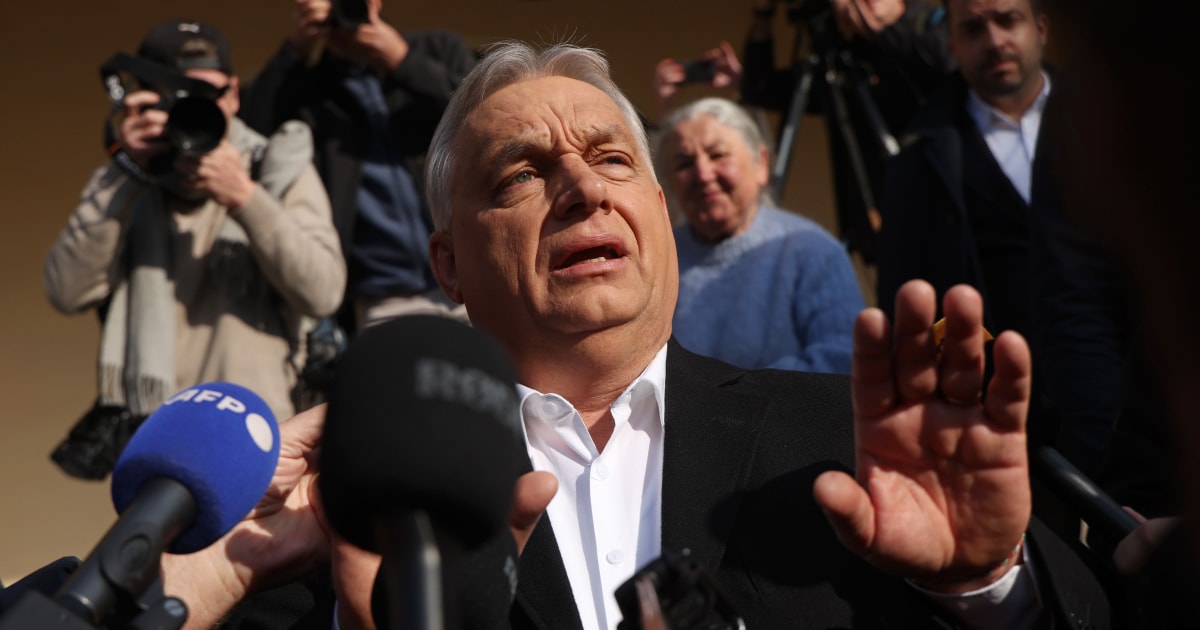


Hungary has ended an era. After sixteen years in power, Viktor Orbán conceded defeat in the April 2026 election, as Péter Magyar’s Tisza Party secured a commanding parliamentary majority and brought a decisive shift in Hungarian politics. The result was emphatic: Orbán’s way, long dominant, was rejected at the ballot box.
Interpretations followed swiftly – and predictably. Across much of Europe, the result was hailed as a ‘return to Europe’, a correction of an illiberal deviation. Among conservatives, especially beyond Hungary, the tone was closer to lament. Yet neither reaction suffices. Orbán’s legacy resists easy categorisation: it requires a more careful judgement.

Orbán governed with clarity of purpose. He placed family, nation and Christian identity at the centre of political life in a way few European leaders have dared to do in recent decades. His constitutional reforms defined marriage in traditional terms, his government introduced extensive pro-family policies, and he gave visible institutional support to the Churches. For many, particularly among conservative Catholics, he represented a rare example of political leadership willing to defend anthropological and moral truths against the pressures of late modern liberalism.
He also reshaped the cultural landscape beyond Hungary. Through institutions, networks and patronage, Orbán fostered a broader European conversation about identity, sovereignty and the place of Christianity in public life. His influence extended far beyond Budapest; he became, for a time, a reference point for a certain kind of post-liberal politics.
None of this should be lightly dismissed. It explains why his defeat is not simply a political event but a cultural moment.
Yet Orbán’s strengths were accompanied by real and evidently mounting weaknesses. Over time, his government came to be associated – fairly or unfairly – with a narrowing of institutional pluralism. Critics pointed to the concentration of media, the reshaping of judicial structures and a political environment in which opposition struggled to compete on equal terms. Hungary’s system was often described as ‘free but not fair’, capturing precisely this tension between electoral legitimacy and structural imbalance.
More significantly, the question of corruption increasingly shadowed his administration. Reports of oligarchic networks, preferential contracts and the enrichment of political allies eroded public trust. What had once been defended as the consolidation of national sovereignty began, in the eyes of many voters, to look like the consolidation of power.
Foreign policy further complicated his position. Orbán’s insistence on a sovereign Hungarian path – especially his cautious and at times conciliatory stance towards Russia, shaped by Hungary’s energy dependence and geographic realities, as well as his repeated clashes with the European Union – won him admirers among those wary of Brussels. Yet it also contributed to Hungary’s growing isolation. Even sympathetic observers began to ask whether this strategic realism remained sustainable, or whether it risked misalignment with Hungary’s longer-term interests within Europe.
These tensions accumulated. By 2026, Orbán faced the most serious electoral challenge of his career, as Péter Magyar – himself a former insider – offered a critique that combined continuity with reform. Magyar’s success lay precisely in this positioning. He did not campaign as a radical liberal break, but as a corrective. He pledged to retain Hungary’s core conservative commitments – particularly on family policy, national identity and a cautious approach to cultural liberalisation – while dismantling what he portrayed as the excesses of Orbán’s system.
Concretely, Magyar has promised to restore institutional balance by strengthening judicial independence, curbing political influence over the media and introducing stricter anti-corruption mechanisms, including cooperation with European legal bodies. At the same time, he has committed to re-engaging ‘constructively’ with the European Union, not as a passive recipient of its directives, but as a credible and reliable partner – seeking both the release of frozen funds and a more stable economic framework.
Economically, he has signalled a turn towards greater transparency and investment, with long-term ambitions such as eventual euro adoption and improved public services. In foreign policy, he aims to anchor Hungary more firmly within NATO and the Western alliance, while maintaining a rhetoric of national sovereignty.
On social questions, however, Magyar has moved carefully. He has not proposed overturning Hungary’s constitutional definition of marriage, nor dismantling its pro-family policies. Yet he has hinted at a more moderate tone – less confrontational, less culture-war-driven – suggesting a shift in style if not in substance.
This combination – structural reform without ideological rupture – allowed Magyar to appeal both to disillusioned conservatives and to voters who had long opposed Orbán, making his candidacy less a revolution than a recalibration.
Voters responded. High turnout and a decisive result suggest not a rejection of everything Orbán represented, but a judgement on how he governed. The distinction matters.
It is too simple, then, to read the election as a repudiation of conservatism. It may instead mark the limits of a particular style of governance. Orbán proved that a politics rooted in cultural and religious identity could command democratic support. His defeat suggests that such a politics cannot indefinitely sustain itself if it appears to drift into insularity, patronage or over-centralisation.
Magyar now inherits both an opportunity and a test. His programme signals a rebalancing: stronger alignment with the EU, an emphasis on rule-of-law reforms and a stated commitment to addressing corruption. At the same time, he has avoided a frontal assault on Hungary’s conservative social framework. Whether this balance can be maintained remains uncertain.
There is, in this sense, a deeper ambiguity to the present moment. Those most eager to celebrate Orbán’s fall may assume that Hungary will simply return to a familiar liberal trajectory. That assumption may prove premature. Magyar’s conservatism – however qualified – may yet surprise his more enthusiastic supporters. Conversely, those who hope for continuity may find that ‘conservative-liberal’ synthesis tends, over time, to resolve itself in one direction rather than the other.
For Catholics, the situation invites a particularly careful response. Orbán’s record on life, family and the public role of Christianity cannot be ignored. Nor can the concerns about governance, justice and the integrity of political institutions. Catholic social thought does not permit an easy trade-off between moral ends and political means. It demands both.
The Hungarian election therefore raises a broader question that extends beyond Hungary itself: can a politics of Christian inspiration avoid both liberal dissolution and illiberal distortion? Orbán answered that question in one way; Magyar will attempt to answer it in another.