

In the first speech of his apostolic voyage to France, Pope Leo strongly denounced surrogacy and assisted suicide, delivering a firm warning to President Emmanuel Macron about the proper relationship between Church and state.
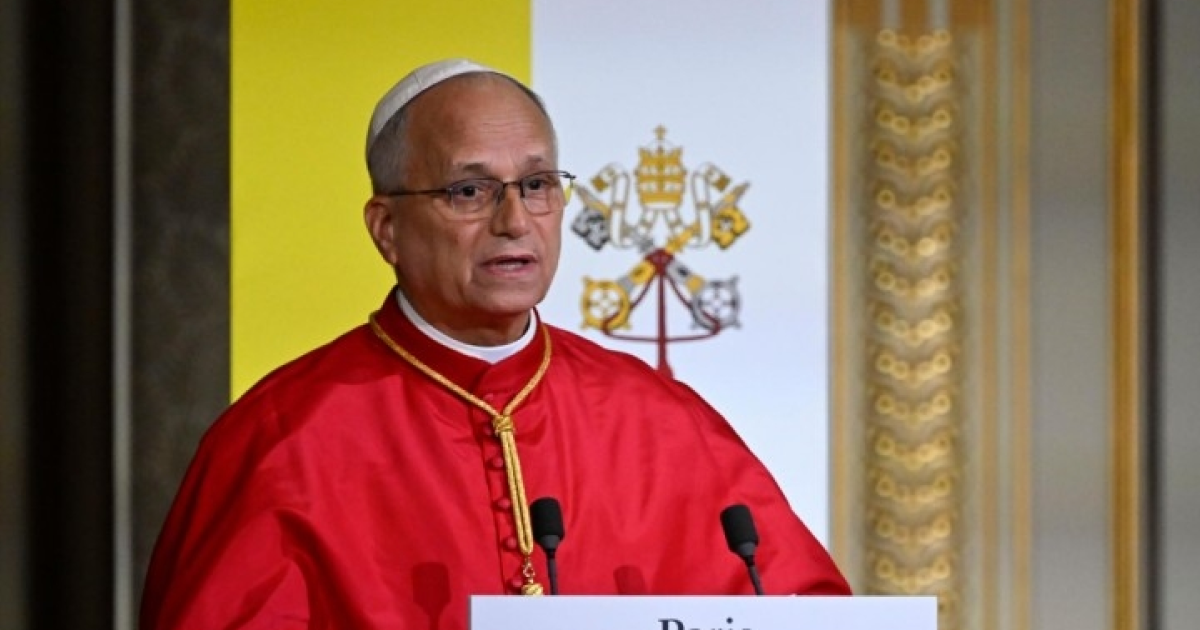
Fresh from a 50-minute private meeting with Macron, Leo XIV stood at the podium in the Elysée Palace for the first public address of his whistle-stop tour of France. The speech, as is customary in the early stages of a papal voyage, was addressed to the assembled politicians, diplomats and civil authorities. Also present were some of the firemen who tackled the 2019 fire that devastated the Cathedral of Notre-Dame – which Leo will visit at the end of his first day.
From the outset of his speech, it was clear that the Pope was in France on a mission to highlight the sanctity of life and the importance of defending it. As for what he perceived as the threat to the sanctity of life, both the anti-life policies of the state and the radical advances of artificial intelligence came under scrutiny.
The Pope also praised the work of Catholic education, the activity of Aid to the Church in Need’s work for persecuted Christians, the historical contribution Catholics have given to make France a great nation and the manner in which Catholicism only aids a society rather than weakens it.
France, he said, has served as a “cultural, artistic and spiritual beacon” for the entire world: the reason being that many of the brilliant scholars were “faithful Catholics” who were always ultimately concerned “that the world may have life”. This phrase he repeated three times throughout the entire speech, leaving the assembly in no doubt as to his response regarding the recently enacted euthanasia and assisted suicide laws.
The Pontiff hailed France’s “Christian roots”, even turning to the catchphrase of the Revolution which became the national motto “Liberté, égalité, fraternité”. These words, said Leo, point to “universal ethical imperatives that also find in the Gospel message an inexhaustible source of inspiration and fulfillment.”
But he did not dwell long on the Revolutionary phrase which was linked to the persecution of so many Catholics. Instead, he moved to the Church’s immense contribution to French society, as shown by its “constant concern for the welfare of the poor and underprivileged” and the way the Church “has sought to be the living face of God’s own mercy and compassion.”
Such witness is an example of true humanity and fraternity, especially regarding the weak and vulnerable, said Leo. Here he took aim at France’s euthanasia and assisted suicide laws, citing his State of the World address from January to declare: “I firmly reiterate that the protection of the right to life constitutes the indispensable foundation of every other human right.”
This provided a ready segue for the Pope to address those laws which really served as the elephant in the room of the entire trip. They have formed the key background to the trip and continue to be present as an undercurrent in his speeches on the first day. Indeed, Leo raised the matter with Macron during their private meeting at the Vatican in April, but with no success.
“Nowadays,” he warned, “there is a temptation to expect science to eliminate or alleviate every form of suffering. This often brings the risk of self-delusion.”
Leo cautioned that “when science and technology are not guided by a deeper wisdom, they can offer immediate solutions that apparently address people’s wishes and their pain, but can seriously divert them from the greater good to which they aspire.”
Standing just metres away from Macron, Leo took aim at the legislation the president’s government had enacted. “I am concerned at times by those trends in society that risk turning science and technology into profit-driven ventures promoting genetic manipulation, surrogacy, the trade in human organs or the possibility of arranging one’s own death.”
He urged that “mutual respect and the protection of every human life is a duty incumbent upon each and every one of us,” and which begins with the “conversion of our minds and hearts”.
Leo argued that failure to do this is a breakdown in the relationship the Church and the state, noting that “authentic secularity does not exclude religion but is capable of valuing it as an educational resource.”
“A Christian engaged in public service and is guided by the light of his or her conscience illumined by faith, cannot be considered a proselytizer or a threat to the unity of the nation,” he stated.
Such a harmony must be respected by the civil institutions, the Pope declared. Well-ordered secular society does not ban religion from the public forum or from education, but works “to ensure that the State and religious institutions maintain dialogue and join forces in the service of the common good, that the world may have life.”
The Pontiff closed by directly quoting Macron’s own words from a 2018 speech, utilising the president’s words as a challenge to urge a defence of life once more:
“A Church that claims to be uninterested in temporal matters would not be fulfilling her vocation; and that a President of the Republic who claims to be uninterested in the Church and in Catholics would be failing in his duty.”
Leo’s address drew from the some of the same themes as his January 2026 State of the World address, ensuring that despite the diplomatic norms of such speeches, his audience was left in no doubt as to his clear intentions. France, he said, is hailed as a great nation but it is the Church which is crucially responsible for all that makes it great. At the heart of those accomplishments over the years, French Catholics had the aim “that the world may have life”, something which Leo firmly enjoined the current politicians to remember.
Michael Haynes is an English journalist in the Holy See Press Corps. He serves as Vatican Correspondent for the Catholic Herald, while readers can follow him at Per Mariam and on X @MLJHaynes.