

Now on the first day of the Feast of Unleavened Bread the disciples came to Jesus, saying, “Where will You have us prepare for You to eat the Passover?” And He said, “Go into the city to such a man, and say to him, ‘The Master says, My time is at hand; I will keep the Passover at your house with My disciples.’”
By the first day of the Feast of Unleavened Bread he means the day before that feast; for they are accustomed to reckon the day from the evening, and he makes mention of that evening in which the Passover must be killed (John 13:1), for on the fifth day of the week they came to Him. One calls this the day before the Feast of Unleavened Bread (Luke 22:7), speaking of the time when they came to Him, and another says, “Then came the day of Unleavened Bread, when the Passover must be killed”; by “came” meaning that it was near, it was at the doors, plainly referring to that evening. For they began with the evening; therefore each adds, “when the Passover was killed”.
And they say, “Where will You have us prepare for You to eat the Passover?” So even from this it is manifest that He had no house, no place of sojourning; and I suppose neither had they. For surely they would have entreated Him to come there. But neither had they any, having now parted with all things.
But why did He keep the Passover? To indicate by all things, even to the last day, that He is not opposed to the law.
And for what possible reason does He send them to an unknown person? To show by this also that He might have avoided suffering. For He who prevailed over this man’s mind, so that he received them, and that by words, what would He not have done with those who crucified Him, if it had been His will not to suffer? And what He did about the ass, this He did here also. For there too He says, “If any man says anything to you, you shall say that the Lord has need of them” (Matthew 21:3); and so likewise here, “The Master says, I will keep the Passover at your house.” But I marvel not only that he received Him, being unknown, but that, expecting to bring upon himself such enmity and implacable hostility, he despised the enmity of the multitude.
After this, because they did not know him, He gave them a sign, as the prophet did concerning Saul, saying, “You shall find one going up and carrying a bottle” (1 Samuel 10:3), and here, carrying a pitcher. And see again the display of His power. For He did not only say, “I will keep the Passover”, but adds another thing also, “My time is at hand.” And this He did, continually reminding His disciples of the Passion, so that, exercised by the frequency of the prediction, they might be prepared for what was to take place; and at the same time to show to them, and to him who was receiving Him, and to all the Jews, that not involuntarily does He come to His Passion. And He adds, “with My disciples”, in order that the preparation should be sufficient, and that the man should not suppose that He was concealing Himself.
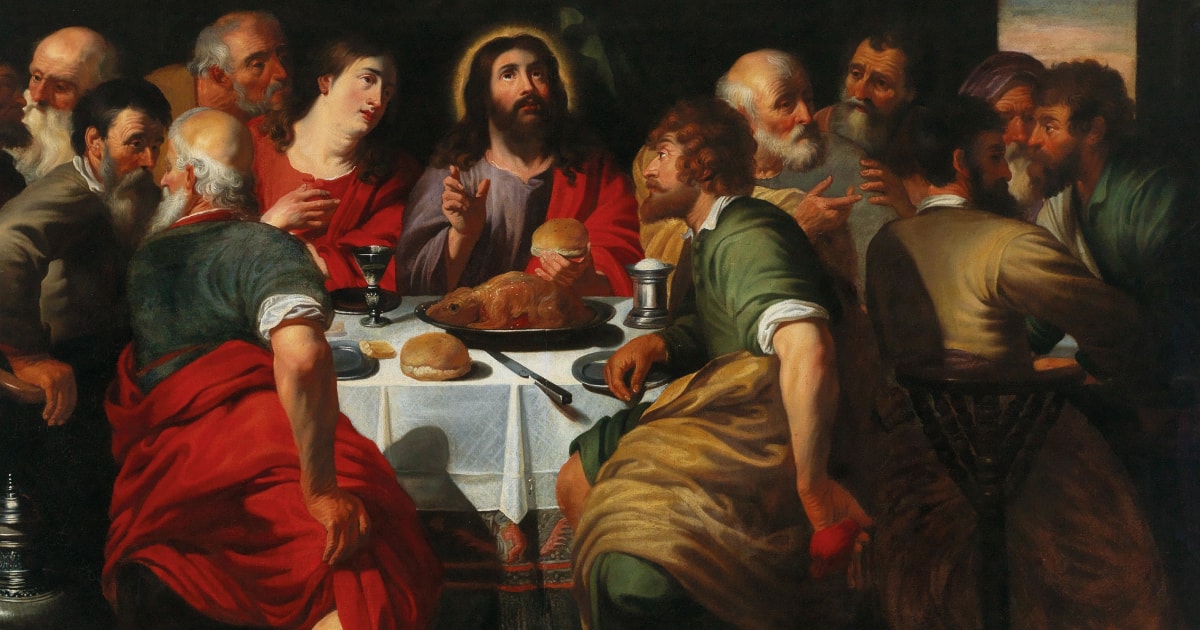
Now when the evening had come, He sat down with the twelve disciples. Oh the shamelessness of Judas! For he too was present, and came to partake both of the mysteries and of the meal, and is convicted at the very table, when, even had he been a wild beast, he might have become tame.
For this cause the evangelist also signifies that while they are eating Christ speaks of His betrayal, so that both by the time and by the table he might show the wickedness of the traitor.
For when the disciples had done as Jesus had appointed them, and when the evening had come, He sat down with the twelve. And as they ate, He said, “Verily, I say to you, that one of you shall betray me.” And before the supper He had even washed his feet. And see how He spares the traitor. For He did not say, “such a one shall betray me”, but “one of you”, so as again to give him power of repentance by concealment. And He chooses to alarm all for the sake of saving this man. “Of you, the twelve,” says He, “who are always with me, whose feet I washed, to whom I promised so many things.”
Intolerable sorrow thereupon seized that holy company. And John says they were in doubt, and looked at one another, and each asked in fear concerning himself, although conscious of no such thing. But this evangelist says that, being exceedingly sorrowful, they began each of them to say to Him, “Is it I, Lord?” (Matthew 26:22). And He answered and said, “He it is, to whom I shall give a sop, when I have dipped it.”
Mark at what time He revealed him. It was when it was His will to deliver the rest from this trouble, for they were almost dead with fear; therefore they pressed Him with their questions. But not only desiring to deliver them from their distress did He do this, but also wishing to amend the traitor. For since, after having often heard it generally, he remained incorrigible and past feeling, He, wishing to move him more, removes his disguise.
For when, being sorrowful, they began to say, “Is it I, Lord?”, He answered and said, “He that dips with me in the dish, the same shall betray me. The Son of Man goes, as it is written of Him, but woe to that man by whom the Son of Man is betrayed. It had been good for that man if he had not been born.”
Now some say that he was so bold as not to honour his Master, but to dip with Him; but it seems to me that Christ did this also to shame him the more and to lead him to a better disposition. For this act again has something more in it.
But these things we ought not to pass over lightly, but they should be instilled in our minds, and wrath would then find no place at any time.
For who, bearing in mind that supper, and the traitor sitting at meat with the Saviour of all, and Him who was to be betrayed thus gently reasoning, would not put away all venom of wrath and anger? See at any rate how gently He conducts Himself towards him: “The Son of Man goes, as it is written of Him.”
And these things again He said both to strengthen the disciples, that they might not think the event a sign of weakness, and to amend the traitor.
“But woe to that man by whom the Son of Man is betrayed! It had been good for that man if he had not been born.” See again in His rebukes His unspeakable gentleness. For not even here does He speak with invective, but rather in the manner of compassion; and yet not only his former senselessness, but his subsequent shamelessness, deserved the utmost indignation. For after this conviction he says, “Is it I, Lord?” Oh insensibility! He asks, while conscious of such things. For the evangelist too, marvelling at his boldness, records this. What then says the most mild and gentle Jesus? “You say.” And yet He might have said, “O you unholy one, accursed and profane, long at work in wickedness, who have made compacts with Satan, agreed to receive money, and have been exposed by me, do you still dare to ask?” But none of these things did He say. Instead He said, “You say”, setting before us a pattern and rule of long suffering.
But someone will say, if it was written that He was to suffer these things, why is Judas blamed, since he did what was written? But he did not act with this intention, but out of wickedness. For if you do not inquire into the motive, you will even absolve the devil of the charges against him. But this is not so. Both the one and the other are deserving of countless punishments, although the world was saved. For it was not the treachery of Judas that worked our salvation, but the wisdom of Christ, and the good ordering of His providence, which used the wickedness of others for our benefit.
What then, one may say, if Judas had not betrayed Him, would not another have betrayed Him? And what has this to do with the question? If Christ had to be crucified, it must be by the agency of someone, and if by someone, then surely by such a person as this. But if all had been good, the dispensation on our behalf would have been hindered. Not so. The All-wise knows how to bring about our good even had this not happened. For His wisdom is rich in resource and beyond comprehension. For this reason, lest anyone suppose that Judas became a minister of the divine plan, He declares the wretchedness of the man. But someone will say again, if it would have been good for him not to have been born, why did He allow both this man and all the wicked to come into the world? When you ought to blame the wicked, for having the power not to become such as they are, yet becoming wicked, you neglect this and busy yourself with the things of God, although you know that no one is wicked by necessity.
But only the good should be born, he will say, and there would be no need of hell, nor punishment, nor vengeance, nor any trace of vice; the wicked should either not be born at all, or, being born, should immediately depart.
First, then, it is well to repeat the saying of the apostle: “But who are you, O man, to answer back to God? Shall the thing formed say to Him who formed it, ‘Why have You made me thus?’”
But if you still demand reasons, we would say this: that the good are more to be admired for being among the bad, because their long-suffering and self-command are then most clearly shown. But you remove the occasion for their struggles and conflicts by saying such things. What then, in order that these may appear good, are others punished? God forbid, but they are punished for their own wickedness. For it was not because they were brought into the world that they became wicked, but on account of their own wickedness; therefore they are punished. For how could they fail to deserve punishment, seeing that they have so many teachers of virtue and yet gain nothing from them? For just as the noble and good are worthy of double honour, because they became good and took no harm from the wicked, so also the worthless deserve double punishment, both because they became wicked when they might have become good, as others show, and because they gained nothing from the good.
But let us see what this wretched man says when convicted by his Master. What then does he say? “Is it I, Rabbi?” (Matthew 26:25). And why did he not ask this from the beginning? He thought to escape notice while it was said, “one of you”; but when He had made him known, he ventured again to ask, trusting in the gentleness of his Master that He would not expose him.
O blindness! Where has it led him? Such is covetousness: it renders men foolish and senseless, reckless, turning them into beasts rather than men, or rather into something more savage than beasts, even devils. This man at least received the devil into himself even while plotting against Him; and Jesus, even while doing him good, he betrayed, having already become a devil in will. For such does the insatiable desire for gain make men, out of their mind, stricken with frenzy, wholly given over to greed, as was the case with Judas.
But how do Matthew and the other evangelists say that when he made the agreement concerning the betrayal the devil seized him, whereas John says that after the sop Satan entered into him (John 13:27)? And John himself knew this, for earlier he says, “The devil had already put it into the heart of Judas to betray Him.” How then does he say, “After the sop Satan entered into him”? Because he does not enter suddenly or all at once, but makes many attempts first, as indeed happened here. For after testing him at the beginning and assailing him quietly, when he saw him ready to receive him, he then fully entered into him and gained complete control.
But how, if they were eating the Passover, did they eat it contrary to the law? For they should not have eaten it sitting down (Exodus 12:11). What then can be said? That after eating it, they then sat down to the meal.
But another evangelist says that on that evening He not only ate the Passover, but also said, “With desire I have desired to eat this Passover with you” (Luke 22:15), that is, in that year. For what reason? Because then the salvation of the world was to be accomplished, the mysteries to be given, and the causes of sorrow to be taken away by His death; so welcome was the Cross to Him. Yet nothing softened that hardened man, nor moved or shamed him. He pronounced him wretched, saying, “Woe to that man.” He warned him again, saying, “It would have been good for him if he had not been born.” He put him to shame, saying, “He to whom I shall give a sop when I have dipped it.” And none of these things restrained him; he was seized by covetousness as by madness, or rather by a more grievous disease, for this indeed is the more grievous madness.
For what would a madman do like this? He did not foam at the mouth, but poured out the murder of his Lord. He did not distort his hands, but stretched them out for the price of precious blood. Therefore his madness was greater, because he was mad while appearing to be in his right mind.
But you say he did not utter meaningless sounds. And what could be more senseless than this: “What will you give me, and I will deliver Him to you?” (Matthew 26:15). “I will deliver Him”: the devil spoke through that mouth. But he did not strike the ground with his feet in struggle? No, and it would have been better if he had struggled so than to stand as he did. But you say he did not cut himself with stones? Yet that would have been better than doing such things as these.
Shall we compare the possessed and the covetous? Let no one take what is said as a reproach to his nature; we do not reproach nature, but lament the act. The possessed man went without clothing, cutting himself with stones, rushing along rough paths, driven headlong by the devil. Do not these things seem dreadful? What then if I show the covetous doing things more grievous than these to their own soul, to such a degree that these seem child’s play by comparison? Do you shun the pest? Come then, let us see whether they are in any respect in a more tolerable state. In none, but in a more grievous condition; for they are more shameful than ten thousand naked men. For it is far better to be naked in body than, clothed in the fruits of covetousness, to go about like those who celebrate the rites of Bacchus. For just as they wear the masks and garments of madmen, so do these; and just as the nakedness of the possessed is caused by madness, so madness produces this clothing, and such clothing is more miserable than nakedness.
And this I will now endeavour to prove. For whom should we say is more mad among madmen themselves: one who cuts himself, or one who harms both himself and those he meets? It is quite clear that it is the latter. The madmen strip themselves of their clothing, but these strip all whom they meet. The former tear their own garments; but how readily would anyone who is injured consent to have his garment torn, rather than be stripped of all his substance?
But the mad do not strike blows at the face. In the first place, the covetous do even this; and if not all, yet all inflict, by famine and penury, more grievous pains upon the body.
But the mad do not bite with their teeth. Would that it were with teeth, and not with the darts of covetousness, fiercer than teeth. For their teeth are weapons and darts. Who suffers more, the one who is bitten once and immediately healed, or the one who is continually consumed by the gnawing of poverty? For involuntary poverty is more grievous than furnace or wild beast.
But they do not rush into the deserts like those possessed by devils. Would that it were the deserts, and not the cities, that they overran, so that all in the cities might enjoy safety. For now, in this respect also, they are more intolerable than all the insane, because they do in the cities what the others do in the deserts, making cities into deserts, and, as in a wilderness where there is none to restrain them, plundering the goods of all.
But they do not pelt with stones those they meet. And what is this? Stones are easy to avoid; but the wounds which they inflict upon the wretched poor by means of paper and ink, drawing up documents full of blows without number, who can easily escape from these?
And let us see also what they do to themselves. They walk naked through the city, for they have no garment of virtue. But if this does not seem to them a disgrace, this too is a mark of their extreme madness, that they have no sense of what is shameful. While they are ashamed to have the body naked, they carry about a naked soul and even glory in it. And if you wish, I will tell you the cause of this insensibility. They are naked among many who are likewise naked, and so they are not ashamed, just as we are not ashamed in the baths. If there were many clothed with virtue, their shame would be more evident. But now this is above all a cause for tears, that because the wicked are many, wickedness is no longer regarded as shameful. For, besides all else, the devil has brought this about, that they do not even perceive their own evil deeds, but, by the multitude of those who practise wickedness, their disgrace is obscured. If such a man were among many who practised self-restraint, he would more clearly perceive his nakedness.
That they are more naked than the possessed is evident from these things; and that they wander into deserts, this also no one could deny. For the broad and easy way is more of a desert than any wilderness. For though many travel upon it, they are not men, but serpents, scorpions, wolves, adders and asps. Such are those who practise wickedness. And this way is not only a desert, but far more rugged than that of the mad. This is clear: for stones and ravines and crags do not wound those who climb them as much as robbery and covetousness wound the souls of those who practise them.
And that they dwell among tombs, like the possessed, or rather that they themselves are tombs, is clear from this. What is a tomb? A stone containing a dead body. In what, then, do these men differ from stones? Indeed, they are more miserable even than stones, for it is not a stone containing a dead body, but a body more insensible than stone, carrying a dead soul. Therefore one would not be wrong to call them tombs. For so our Lord called the Jews, saying, “Their inward parts are full of ravening and covetousness.”
Would you have me show how they also strike their heads with stones? From where shall we learn this, from things present or from things to come? They do not regard what is to come; we must speak, then, of what is present. Are not anxieties more grievous than many stones, not wounding the head, but consuming the soul? For they are afraid lest what has come to them unjustly should justly depart from them; they tremble in fear of the worst evils, they grow angry, they are provoked against those of their own household and against strangers. Now despondency, now fear, now anger come upon them in turn, and they are as if passing from one precipice to another, anxiously seeking each day what they have not yet acquired. Therefore they take no pleasure in what they possess, both because they feel no confidence in its security and because their whole mind is fixed on what they have not yet seized. And like one continually thirsting, who, though he drinks from countless fountains, feels no satisfaction because his thirst is not quenched, so also these, far from finding pleasure, are tormented the more they accumulate, because they set no limit to their desire.
And things here are thus; but let us speak also of the day to come. For though they give no heed, yet it is necessary for us to speak. In that day, one will see everywhere such men as these undergoing punishment. For when He says, “I was hungry and you gave me no food; I was thirsty and you gave me no drink” (Matthew 25:42), He is punishing these; and when He says, “Depart into the eternal fire prepared for the devil” (Matthew 25:41), He is sending there those who misuse riches. And the wicked servant, who does not give to his fellow servants the goods of his lord, is among these men, as are he who buried his talent and the five virgins.
And wherever you go, you will see the covetous punished. Now they will hear, “There is a great chasm fixed between us and you”; now, “Depart from me into the fire that is prepared” (Matthew 25:41). And now, being cut asunder, they will go away where there is gnashing of teeth; from every place they are driven, finding rest nowhere, but gathered together in hell alone.
What, then, is the use of the right faith for our salvation, when we hear these things? There, gnashing of teeth, outer darkness, the fire prepared for the devil, to be cut asunder, to be driven away; here, enmities, evil speaking, slanders, perils, cares, plots, to be hated by all, to be abhorred by all, even by those who seem to flatter us. For as good men are admired not only by the good but even by the wicked, so bad men are hated not only by the good but also by the worthless. And to show that this is true, I would gladly ask the covetous whether they do not feel hostility towards one another, and regard such men as greater enemies than those who have done them the greatest wrong; whether they do not accuse themselves; whether they do not count it an insult if anyone brings this reproach against them. For indeed this is an extreme reproach and a clear proof of great wickedness. For if you cannot bring yourself to despise wealth, of what will you ever gain mastery? Of lust, or of the mad desire for glory, or anger, or wrath? And how could anyone be persuaded of it? For with regard to lust, anger and wrath, many attribute them to the temperament of the body, and students of medicine refer such excesses to this, saying that one of a hotter and more languid constitution is more prone to lust, and one of a drier temperament more eager, irritable and wrathful. But with regard to covetousness, no one has ever said anything of the sort. So entirely is this vice the result of mere negligence and of a soul past feeling.
Therefore I beseech you, let us be diligent in correcting all such things, and in directing the passions that arise within us towards what is good at every stage of life. But if in every part of our life we pass by the labours of virtue, suffering shipwreck everywhere, when we reach the harbour without spiritual freight, we shall undergo severe punishment. For our present life is like an open sea. And as in the sea there are different regions exposed to different storms, the Aegean difficult because of its winds, the Tyrrhenian strait because of its narrowness, the Charybdis near Africa because of its shallows, the Propontis, outside the Euxine, because of its violence and currents, the regions beyond Cadiz because of their desolation and tracklessness, and other parts for other reasons; so it is also in our life.
The first sea to be considered is that of childhood, full of storms because of its folly and instability. Therefore we set over it guides and teachers, by our care supplying what nature lacks, as a pilot does by skill.
After this comes the sea of youth, where the winds are violent, as in the Aegean, as desire increases within us. This age especially lacks correction, not only because it is more fiercely assailed, but also because its faults are not reproved, since both teacher and guide withdraw. When, therefore, the winds blow more violently, the pilot is weaker, and there is no helper, consider the force of the storm.
After this comes another stage of life, that of adulthood, in which the cares of the household press upon us: marriage, the raising of children, the running of a household, and a constant downpour of concerns. Then especially covetousness and envy flourish.
If, then, we pass through each stage of life suffering shipwreck, how shall we endure the present life? How shall we escape future punishment? For if in our earliest years we learn nothing good, and in youth we do not practise self-control, and in adulthood we do not overcome covetousness, then we come to old age like a vessel full of bilge water, having weakened the ship of the soul by many blows, its planks loosened. We shall reach that harbour bearing filth instead of spiritual merchandise, bringing laughter to the devil and lamentation upon ourselves, and so incur unbearable punishments.
That this may not be so, let us strengthen ourselves on every side and resist all our passions. Let us cast out the love of wealth, that we may attain the good things to come, by the grace and love of our Lord Jesus Christ, to whom be glory for ever and ever. Amen.