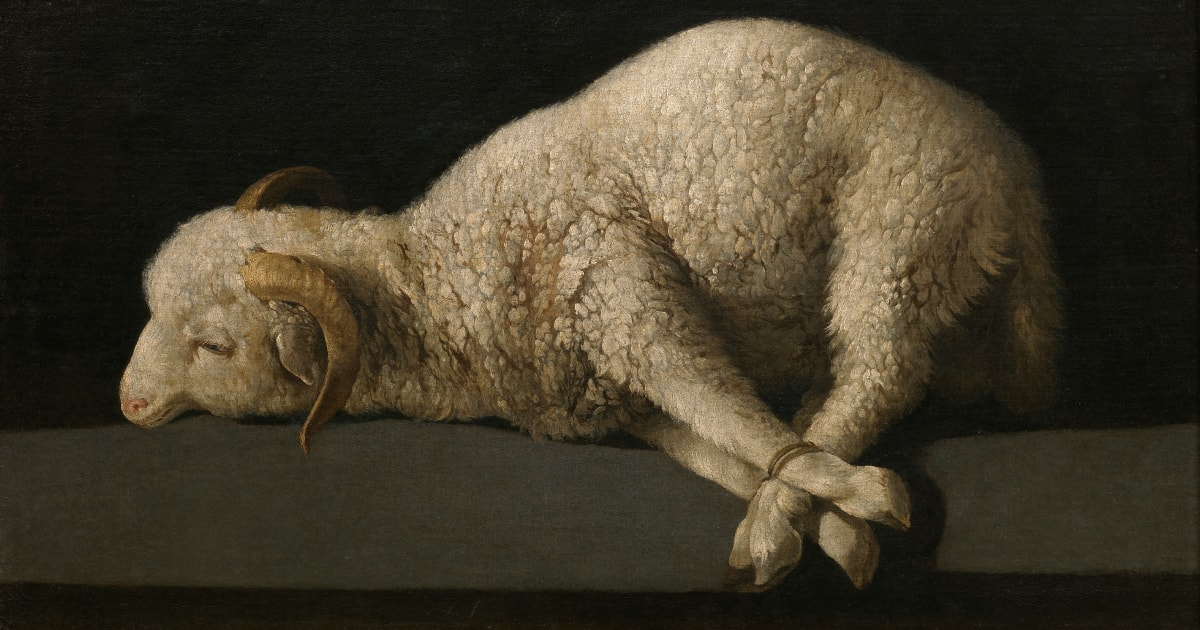
The Paschal Mystery is Jesus’s great Exodus. Throughout the whole period of his public ministry, he framed the work of salvation in this light: bringing about freedom for captives, offering a new manna from heaven, and instituting a new Passover sealed in his own blood, just as Moses had sealed a covenant in blood at Mt Sinai. In giving his Body and Blood, Jesus made himself the new Passover lamb offered for the salvation of the people he would gather to himself in faith.
Jesus’s great Exodus does not simply look back to the first metaphorically. He institutes a new exit from a place of slavery to one of abundance, making an actual journey that would change humanity itself. The original Passover was celebrated in haste to prepare for a flight the following day. Likewise, Jesus spoke of his imminent departure from the world to a place also attached to a promise, one that he lays out to his disciples. Peter, sensing the reality of his departure, asks him: “Lord, where are you going?” Jesus answered, “Where I am going you cannot follow me now; but you shall follow afterward” (John 14:36).
Although Jesus does not answer Peter’s question immediately, when you pay attention to the entire farewell discourse at the Last Supper, he teaches us exactly how his death and resurrection open up a clear itinerary we are meant to follow. Just as the Israelites left Egypt to return to Canaan, from which their ancestors had come, Jesus explained: “I came from the Father and have come into the world; again, I am leaving the world and going to the Father” (John 16:8). Just as Pharaoh was overcome by the plagues, so Jesus asserted: “I have overcome the world” (16:33). Rather than displaying raw power against his enemy, Jesus humbles the “prince of the world,” as he calls him, by allowing him to appear to triumph. It is his humble love and self-emptying that open up a path through the wilderness that will enable his disciples to follow behind him.
Maundy Thursday teaches us that if we want to follow in his footsteps, we must love like him. Moses gave the Israelites Ten Commandments, while Jesus gives the disciples one single command at the Last Supper: to love as he loves. This is the key to overcoming the world and following Jesus (who, as his name indicates, is the new Joshua) in his conquest of the evil one. His Exodus from death to life has the Father as its goal, and the victory he achieves over sin and death opens up this as the destination for all his disciples. “In my Father’s house are many rooms; if it were not so, would I have told you that I go to prepare a place for you? And when I go and prepare a place for you, I will come again and will take you to myself, that where I am you may be also” (John 14:2–3).
The Israelites had a difficult trek through the wilderness, to say the least. Most of them did not make it into the promised land, spending an entire generation resisting the Lord’s direction and looking back to the fleshpots of Egypt. Jesus wants to make the way smoother for his disciples, laying out a clear path for them to follow: “‘Thomas said to him, ‘Lord, we do not know where you are going; how can we know the way?’ Jesus said to him, “I am the way, and the truth, and the life; no one comes to the Father, but by me. If you had known me, you would have known my Father also; henceforth you know him and have seen him” (John 14:5–7). And if showing us the steps to walk were not enough, he offered a guide along the way. The Israelites followed a pillar of cloud and fire, but Jesus’s disciples will have an advocate guiding them from within: “And I will pray the Father, and he will give you another Counsellor, to be with you for ever, even the Spirit of truth, whom the world cannot receive, because it neither sees him nor knows him; you know him, for he dwells with you, and will be in you” (John 14:16–17).
The journey to the Father is well provisioned: a way, a guide, and, of course, food and drink to provide strength along the way. This will be necessary because, although Jesus makes the journey in three days, his disciples will have to undergo a period of testing like the Israelites in the desert. Jesus’s Exodus out of the world provides an anchor for the disciples in heaven, yet they must remain in the world and continue to journey with the assistance he offers. Jesus says that the disciples “are not of the world” but chosen out of it (John 15:19), while also refraining from praying that the Father should take them out of the world (John 17:15). That means we are meant to be here in a continual state of Exodus, following behind Jesus on the way to the Father’s house but also journeying in the world.
In fact, in his priestly prayer in John 17, Jesus says that he sends his disciples into the world, into the place of rebellion. In the original Exodus, the Israelites despoiled the Egyptians and left it behind for the promised land. Now, even though Jesus leaves the world, he sends us into it, equipped to share the fruit of his Paschal Mystery as an ongoing rescue mission. He wants us to share the truth of who he is and what he has done for us: “They are not of the world, even as I am not of the world. Sanctify them in the truth; thy word is truth. As thou didst send me into the world, so I have sent them into the world” (John 17:16–18).
We are not of the world because Jesus has overcome it. It no longer has dominion over us, even if we suffer on the arduous pilgrimage through it. This journey is redemptive, the slow working out of the grace of the Paschal Mystery within us, and one that is meant to spread to others. We do not leave the world behind to its own devices because we are meant to follow the path Jesus walked, pouring ourselves out in love for others as we share in his great work of liberation.