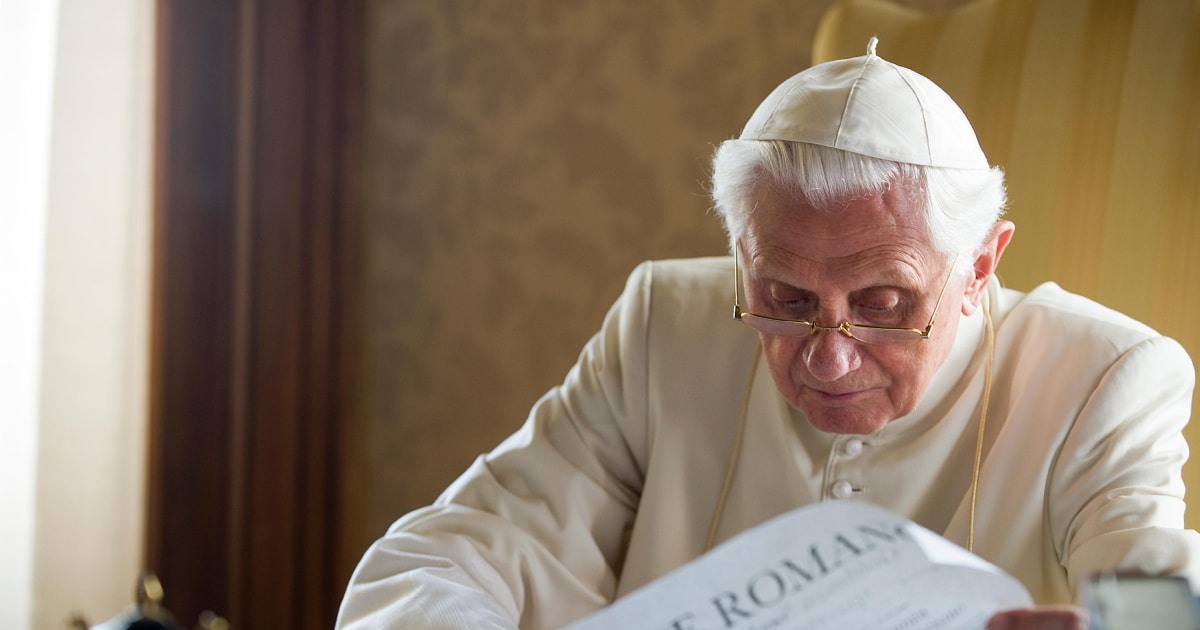
A new organisation dedicated to fostering a renewed sense of ‘Catholic identity’ based on the vision of Pope Emeritus Benedict XVI took flight in Rome last week, marking the 99th birthday of the late German pontiff.
Launched on April 16, the new Benedict XVI Society describes itself as having a ‘transformative mission’, looking to ‘renew and strengthen Catholic identity through education, formation and global evangelisation rooted in the theological vision of Pope Benedict XVI’.
Marking the Society’s public beginnings, a Mass was offered in the Vatican by one of Benedict’s close friends – Cardinal Kurt Koch – before invited guests attended a conference at the Pontifical Academy of Sciences, where key themes of Benedict’s legacy and the Society’s aims were discussed.
The German pontiff’s writings have long been championed by his many students and admirers, but in recent years a growing collective of academics and clerics in Rome have been keen to ensure that an accurate legacy of Benedict’s work is promoted. (A five-day event is planned for July in the Bavarian pilgrimage town of Altötting.)
In many ways, the beginning of such an organisation at this moment is not surprising and quite opportune. With increasing regularity, Pope Leo XIV has cited Benedict XVI during his own homilies and addresses – including, for instance, just this week while meeting local clergy in Angola. The regularity of Leo’s references to Benedict comes as a subtle change in tone in the Vatican, given that such quotations or homiletic citations under Pope Francis were notably rare. With a quiet but demonstrative shift in papal openness to Benedict’s style, and the consequent uptick in general interest, the need for a careful curation of the late pope’s work is hence increased.
Formally launched on Benedict’s birthday last week, the Benedict XVI Society will be operating in full swing by the time of the German pontiff’s 100th birthday in 2027. It is fair to say that a renewed attention to Benedict is being witnessed in certain parts of the Eternal City.
As professed clearly by the Society, it ‘promotes the Catholic faith on the basis of non-negotiable theological principles in the spirit of Benedict XVI’. This is a forthright and simple mission statement, seeking to provide a welcome element of doctrinal clarity in an age where clerics can be more confusingly verbose than filibustering politicians. The Society also ‘preserves and communicates the central truths of the faith (fides quae) and combines these with a just, responsible and forward-looking commitment to the renewal of the Church and society’.
Channelling Benedict’s legacy, the fledgling group thus aims to give rise to a ‘global movement in the Church’, led and guided by well-trained theologians who will combine theology, spirituality and culture in one united front to ‘renew and strengthen Catholic identity’.
One chief way this will be attempted is through a variety of educational and spiritual initiatives, from kindergarten up to the doctoral research level. Such formation is described by the Society as being ‘the art of helping people not only understand their faith, but live it’.
In practice, this will be enabled through the Society’s stated aim of schools that ‘embody the theological clarity, intellectual depth and moral vision associated with Benedict XVI’, and seminarians or post-graduate researchers who ‘demonstrate a strong affinity for the theological richness and pastoral vision of Benedict XVI’.
Seeking to implement a true spread of Benedict’s style across these varied levels of educational centres, the Society notes that formation must be linked to practice of the faith: ‘education without practice remains empty, so we connect reflection with action, encouraging participants to apply what they have learned in their communities and personal lives.’
Unsurprisingly, a particular focus will be devoted to liturgy. The liturgical question is a well-documented point of division in the Church today, and in light of this many have urged a return to Benedict XVI’s calmer approach to liturgy, instead of the upheaval which has issued from the Vatican during the previous pontificate.
For instance, two close collaborators of the late pope – Archbishop Georg Gänswein and Cardinal Gerhard Müller – recently called for a return to Benedict’s approach to the traditional Mass. ‘I never understood why Pope Francis introduced this restriction,’ said Gänswein. ‘It is and remains a mystery to me.’
Outlining the liturgical goals of the Benedict XVI Society, Fr Edward Hauschild pointed to Ratzinger’s many writings, and in particular his 2001 essay delivered at the Benedictine Abbey of Fontgombault and his book The Spirit of the Liturgy. In that latter text, Fr Hauschild said, Ratzinger reveals his desire to ‘inspire a new Liturgical Movement’, the seeds of which ‘have already been planted, and in the parishes and religious communities that embraced Benedict XVI’s vision for the enrichment of the liturgy, we have seen the first green shoots, the beginnings of a revival’.
Fr Hauschild, studying moral theology in Rome as a priest for the Diocese of Portsmouth, declared that the Society especially aims to promote Benedict’s ‘positive vision’ for the liturgy via two goals: ‘a new reverence for the Liturgy and a fresh understanding of it as an encounter with God’.
This will be no airy-minded endeavour but a very practical approach, as the Society aims to train priests and laity in the ‘proper celebration’ via conferences, training materials, catechetical and devotional works, encouraging the practice of ‘neglected’ devotions, and also assisting families in living the fullness of the liturgical year in their homes.
‘By promoting this renewal of the Sacred Liturgy, we hope to aid the great work of evangelisation, by making possible the encounter with God, Father, Son and Holy Spirit, in the Sacred Liturgy,’ he said.
Delivering the homily for the Mass commemorating Benedict on April 16, Cardinal Koch commented how gratitude for the life of the late pope ‘is only credible if we allow ourselves to be encouraged by the witness of Pope Benedict, recognising that we too are sent to bear witness and to bring to people on this Holy Saturday the joyful and hopeful message of today’s Gospel: “Whoever believes in the Son has eternal life”’.
With its multi-faceted approach to renewing and strengthening the Catholic faith through careful study, reverent liturgy and a lively personal faith, the Benedict XVI Society aims to heed the cardinal’s recommendation. Benedict’s name is not something to be simply cited, but to be used as part of an invigorated effort to dynamise the fullness of Catholicism so as to satisfy the ‘real hunger for the divine’ which so many in the world are feeling.


.jpg)