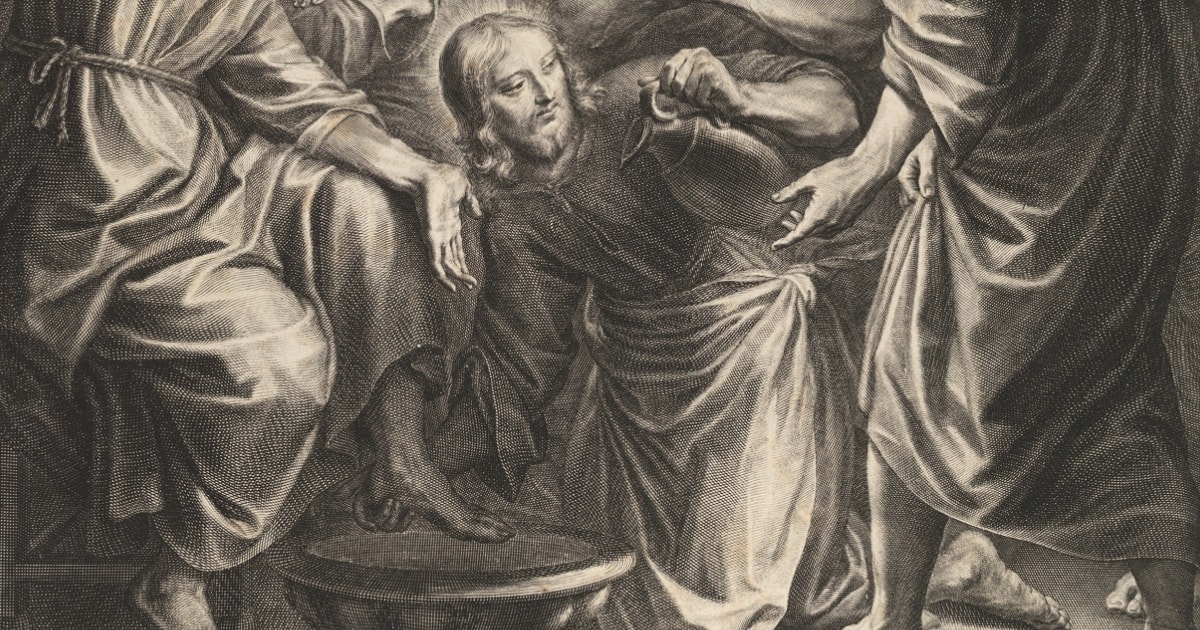
When the Lord was washing the disciples’ feet, He came to Simon Peter; and Peter said to Him, “Lord, do You wash my feet?” For who would not be filled with fear at having his feet washed by the Son of God? Although, therefore, it was an act of the greatest audacity for the servant to contradict his Lord, the creature his God, yet Peter preferred this to allowing his feet to be washed by his Lord and God.
Nor ought we to think that Peter was one among others who expressed their fear and refusal in this way, seeing that others before him had allowed it to be done to them with cheerfulness and equanimity. For it is easier to understand the words of the Gospel in this way, because, after saying, “He began to wash the disciples’ feet, and to wipe them with the towel with which He was girded”, it is then added, “Then He came to Simon Peter”, as if He had already washed the feet of some, and after them had now come to the first of them all. For who can fail to know that the most blessed Peter was the first of the apostles?
But we are not to understand it as though He came to him after some others, but that He began with him. When, therefore, He began to wash the disciples’ feet, He came to him with whom He began, namely Peter; and then Peter took fright at what any one of them might have been frightened by, and said, “Lord, do You wash my feet?” What is implied in this “You”? And what in “my”? These are matters for thought rather than speech, lest any conception the soul may have formed should fail in expression.
But Jesus answered him, “What I do you do not know now, but you shall know hereafter.” And not even yet, terrified as he was by the sublimity of the Lord’s action, does he allow it to be done, while ignorant of its purpose; but is unwilling to see, unable to endure, that Christ should thus humble Himself to his very feet. “You shall never wash my feet,” he says. What is this “never” [in æternum]? I will never endure it, never suffer it, never permit it; that is, a thing is not done in æternum which is never done. Then the Saviour, to alarm His reluctant patient with the danger to his own salvation, says, “If I do not wash you, you have no part with me.” He speaks in this way, “If I do not wash you”, when He was referring only to his feet; just as it is customary to say, “You are trampling on me”, when it is only the foot that is trampled on. And now the other, in a turmoil of love and fear, and more afraid that Christ should be withheld from him than even to see Him humbled at his feet, exclaims, “Lord, not my feet only, but also my hands and my head.” Since this, indeed, is Your warning, that my bodily members must be washed by You, I no longer withhold the lowest, but I lay the foremost also at Your disposal. Deny me not a share with You, and I deny You no part of my body to be washed.
Jesus says to him, “He who is washed does not need to wash, except for his feet, but is completely clean.” Some may be stirred by this and say: if he is completely clean, what need has he even to wash his feet? But the Lord knew what He was saying, even though our weakness cannot reach into His hidden purposes. Nevertheless, so far as He is pleased to instruct and teach us, according to the small measure of my understanding, I would also, with His help, offer some answer to this question; and, first of all, there is no contradiction in the expression. For who may not say, with perfect propriety, “He is completely clean, except his feet?” although it would be more elegant to say, “He is completely clean, save his feet”, which is equivalent in meaning. Thus, then, the Lord says, “He needs only to wash his feet, but is completely clean”; that is, except his feet, which still need washing.
But what does this mean? The Lord says, the Truth declares, that even one who has been washed still needs to wash his feet. What, my brethren, are we to understand by this, except that in holy Baptism a man is wholly washed, not all save his feet, but entirely; and yet, while he lives in this mortal state, he cannot fail to tread on the earth with his feet? Thus our human affections, inseparable from our life on earth, are like feet by which we are brought into contact with human affairs; and in such a way that, if we say we have no sin, we deceive ourselves, and the truth is not in us. And every day, therefore, He who intercedes for us is washing our feet; and that we too have daily need to wash our feet, that is, to order rightly the path of our spiritual steps, we acknowledge even in the Lord’s Prayer when we say, “Forgive us our debts, as we also forgive our debtors.” For if, as it is written, we confess our sins, then He who washed His disciples’ feet is faithful and just to forgive us our sins and to cleanse us from all unrighteousness, even to our feet with which we walk upon the earth.
Accordingly the Church, which Christ cleanses by the washing of water with the word, is without spot or wrinkle, not only in the case of those who are taken from this life immediately after the washing of regeneration and do not tread the earth so as to require the washing of their feet, but also in those who have received such mercy from the Lord as to depart this life with feet that have been washed. Although the Church is clean in those who remain on earth, because they live righteously, they still need to wash their feet, because they are not without sin. For this reason it is said in the Song of Songs, “I have washed my feet; how shall I defile them?” One speaks thus when he is compelled to come to Christ and, in coming, must bring his feet into contact with the ground. But another question arises. Is not Christ above? Has He not ascended into heaven and does He not sit at the Father’s right hand? Does not the apostle say, “If you have been raised with Christ, set your minds on things above, where Christ is seated at the right hand of God. Seek the things that are above, not those on earth”?
How is it, then, that in coming to Christ we are compelled to tread upon the earth, when rather our hearts should be lifted upwards to the Lord, that we may dwell in His presence? You see, brethren, the shortness of the time today limits our consideration of this question. If you find yourselves unable fully to grasp it, I too see how much further explanation it requires. I therefore ask you to allow it to be deferred rather than treated too briefly and inadequately; your expectation will not be disappointed, only postponed. For the Lord, who thus makes us your debtors, will be present to enable us also to discharge our debt.