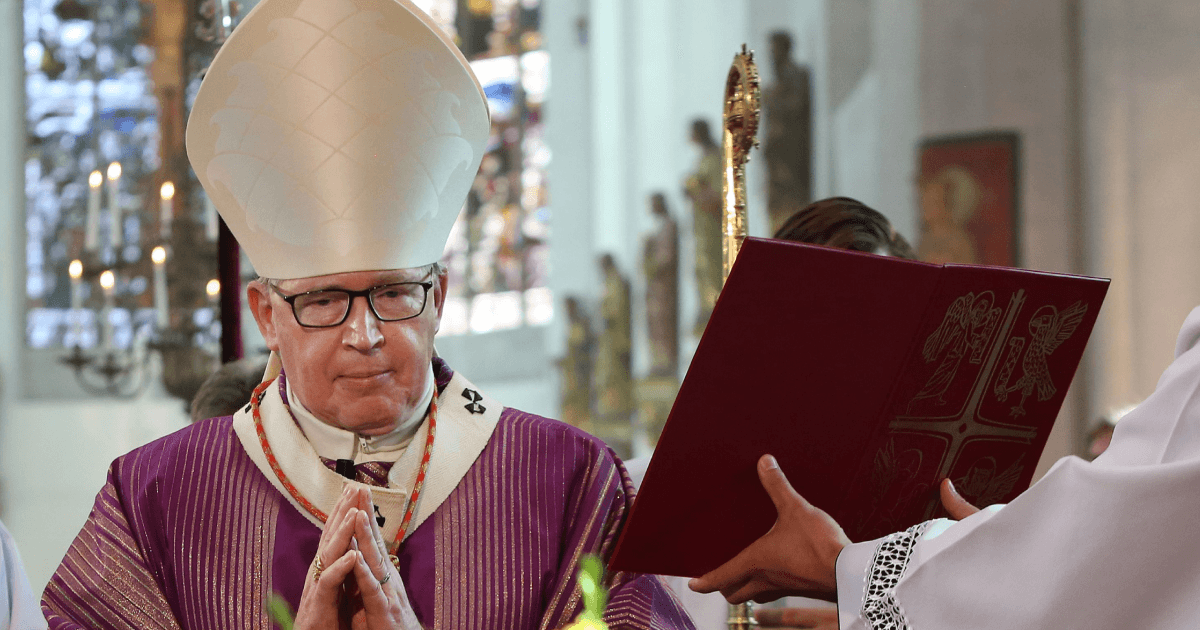


Monsignor Marco Agostini has been dismissed from his post at the Office for the Liturgical Celebrations of the Supreme Pontiff following the emergence of a recording in which he allegedly used an inappropriate term while referring to members of the Roman Curia.
The decision was taken after an audio clip circulated online in which a voice identified as that of the senior Vatican cleric can be heard using the Italian slur “culattoni”, a term equivalent to the English word “faggot”, during a private exchange ahead of a Christmas greeting with Pope Leo XIV and the Curia. Reports indicate that the remark was made unknowingly while a microphone was still switched on. Furthermore, before Leo XIV delivered his address, Monsignor Agostini was heard on the open microphone saying “assholes, all together”, referring to the Curia.
Monsignor Agostini, a priest of the Diocese of Verona, had served for many years as a papal master of ceremonies, becoming a familiar figure alongside the Pope during major liturgical events. His removal from office followed the publication of the recording by Silere Non Possum, though no detailed official statement has been issued by the Holy See.
Previously, he served as an official in the Secretariat of State, working in the Section for Relations with States. The role, often described as a training ground for curial discipline and confidentiality, further consolidated his standing as a trusted cleric accustomed to working within the structures of the Holy See.
In June 2009, during the pontificate of Benedict XVI, Agostini was appointed Pontifical Master of Ceremonies. He remained in the post for more than sixteen years, serving under three pontificates. His unusually long tenure was widely seen as a sign of institutional confidence and technical competence. However, following his dismissal, some Catholic media outlets have suggested that Agostini had previously been viewed with suspicion because of his closeness to the Latin Mass.
Public support for the former papal ceremoniere has emerged in Italy. In recent days, the Hon. Vito Comencini, a member of the Italian Chamber of Deputies and President of the Popolo Veneto association, issued a letter expressing solidarity with Monsignor Agostini. In the statement, Comencini described the punishment as “unjust and foolish”, adding that it represented a “worrying sign of persecution”.
Much of the immediate coverage of the controversy focused on liturgy or sexuality. What was often missed, however, was the broader question of the Church’s limits of tolerance and how it regulates itself in an increasingly hypersensitive world.
Monsignor Agostini’s alleged remark, recorded unknowingly and circulated online without contextual clarification, was undoubtedly inappropriate. Few would defend the language itself, and fewer still would argue that such words should be used by a cleric closely associated with the Pope’s liturgical governance. Yet the Church has never judged speech in isolation from intention, context, or character. Moral theology has long insisted on distinctions between form and substance, between sin and scandal, and between private fault and public office.
The Church is not merely another institution managing reputational risk. It claims to be a moral teacher, one that insists on proportionality and mercy even when discipline is required. When disciplinary decisions are taken without transparency, as in this case, the silence of the Vatican creates a vacuum into which competing narratives rush.
Agostini is not a marginal figure. He has spent more than sixteen years in Rome across three pontificates and has carried out a role requiring obedience and trust. His longevity in such a post is itself evidence of confidence. His known closeness to the traditional Roman liturgy has inevitably shaped how his dismissal has been received. Among traditionalist Catholics, the episode has been interpreted not merely as discipline but as confirmation of a broader pattern in which figures associated with older liturgical sensibilities are held to different and harsher standards.
Comparison with earlier papal conduct has therefore become unavoidable. During the pontificate of Pope Francis, informal language and off-the-cuff remarks, including the use of the same slur, were publicly acknowledged and widely reported. Those incidents were generally treated as missteps or cultural awkwardness rather than as grounds for institutional sanction. The contrast is clear, and it feeds suspicion that disciplinary thresholds are unevenly applied.
The central issue, then, is not whether Agostini’s wording was wrong. It was crude and unprofessional. The deeper question is whether the Church is drifting towards a managerial model of governance in which optics and public pressure outweigh discernment. If so, the risk is a loss of moral credibility.
There is also a cultural question at play. Traditional Catholicism is often caricatured as an obsession with externals, sometimes dismissed as “smells and bells”. Yet the concern voiced by many conservatives is not aesthetic but moral coherence. Defenders of Monsignor Agostini do not claim that he harboured contempt for individuals or homosexuals. Rather, they argue that his private frustration was directed at what he perceived as dysfunction within the Curia. The modern insistence that every utterance be treated as a public declaration marks a significant shift in how authority is exercised.
Attention has now turned to Monsignor Agostini’s future. What is clear is that his sudden removal has unsettled a network of clergy and laity who already feel marginalised. Public support, including from figures such as Vito Comencini of the Popolo Veneto association, suggests that the controversy will not fade quietly.


.jpg)