The Triduum is nearly here, which makes this the perfect time to meditate on death. Easter Sunday comes only after Gethsemane and Golgotha. We want the Resurrection, but first there is the Passion. In much the same way, we desire the promise of heaven without passing through the exacting reality of sanctification and death. The way this age ignores Good Friday and rushes to Easter Sunday closely resembles its approach to death and salvation. Our generation desires an end that is both unambiguous and decidedly happy, leaving little room for grief, judgement or transformation. In this way, we are tempted to skip not only Good Friday, but everything it requires: justice, purification and the cost of resurrection.
With little exception, our time seems to regard heaven as the common lot of all men. No sooner has one shuffled off this mortal coil than a dozen or more social media posts attest to his seat in paradise. This instinct, though often well meaning, flattens the moral landscape. It assumes mercy without judgement, welcome without reckoning and heaven without change. There is a great deal of brokenness in this world. We have all done our part to contribute to it. Forgiveness does not mean the damage has vanished. A man may be forgiven his debts and yet remain bound by the habits that incurred them. Mercy restores the relationship, but it does not, by itself, restore the soul. For that reason, sorrow for sin is not an optional sentiment but a necessary movement towards wholeness. Grace does not merely overlook. It transforms. And so mercy is sweetest not when it ignores justice, but when it fulfils it.
If some avoid the weight of judgement by presuming heaven, others avoid it by denying any final judgement at all. Some men find it profound to say that life has meaning only because it ends. A final stilling, a night with no new sun on its horizon, the snuffing out of thought and self, is preferred to the Four Last Things. This often betrays either a diminished sense of the joy of the Father’s embrace or a desire to avoid the judge’s sentence. There are many reasons why one might reject a final reckoning. The Catholic feels the error in this more than he sees it. It is like saying that there is meaning in a story because it has no resolution, or in a joke because it has no punchline. The annihilation of the self is not an ending. It is a refusal to finish. It does not conclude the story. It abandons it.
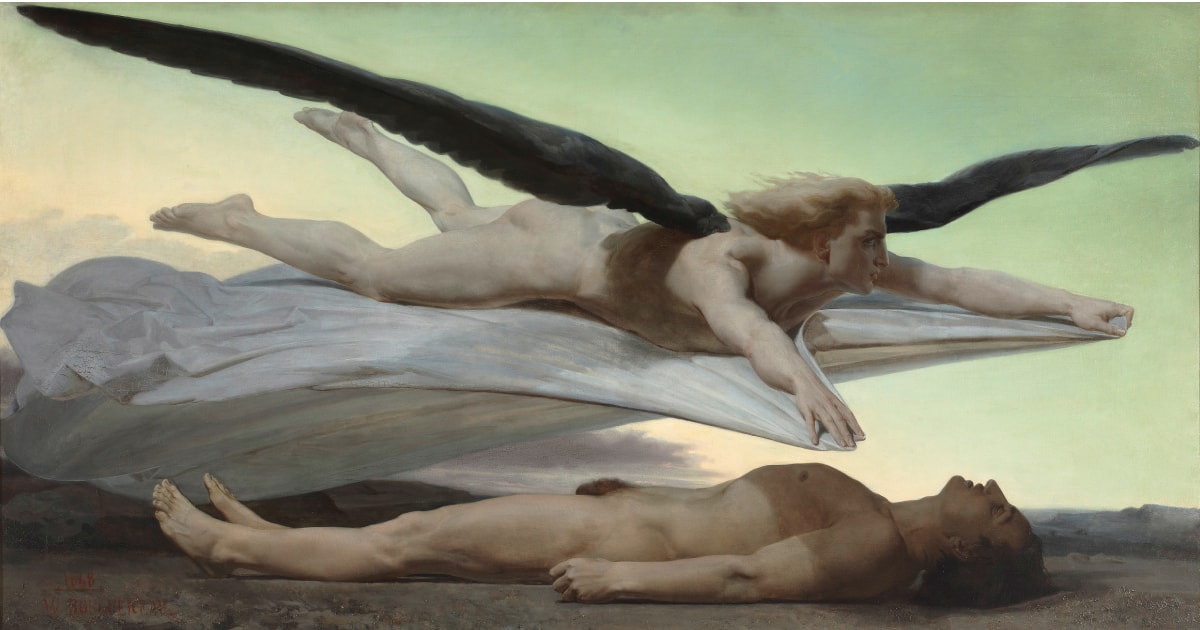
C. S. Lewis once suggested that Heaven and Hell are, in a sense, retrospective, that each soul comes to see its life in light of its final end. But if death simply ended all things equally, if it silenced both the wicked and the righteous without distinction, then it would not complete a life so much as interrupt it. A just ending must reveal what a life has meant. Otherwise, judgement disappears, and with it any meaningful distinction between good and evil. Death may stop wickedness, and that is good, but if it stops righteousness as well, then something essential is missing. This same instinct, to avoid the full weight of death, appears even within Christianity itself.
The Catholic imagination refuses to sanitise death or simplify redemption. It keeps before its eyes not only the cross, but the crucified Christ. It allows the darkness its full weight, so that the light may be seen for what it is.
Death in the Catholic tradition is a less settled matter than most modern men would like. There is little in the Requiem Mass that resembles a modern “celebration of life”. There is uncertainty about salvation, meditation on Divine Justice and profound supplication on behalf of the faithful departed. Conversely, there is an ever growing number for whom their final breath holds little fear. These Christians enjoy something approaching an absolute assurance of salvation. While not without its appeal, it bears little resemblance to the tone of tradition. It is not unfair to say that something very real is left out of this picture. For the Christian tradition has long held that a certain fear is not a defect, but the beginning of wisdom.
The Catholic is no nihilist, nor does he enjoy any easy assurance of salvation. The Catholic not only celebrates life, but mourns death for its loss. He supplicates for that soul, which, like his own, knew sin. He sees in the dead his own fate and remembers the sin that still holds him back from God. He sees God’s merciful love, which is precisely why he supplicates. He does not canonise the dead out of sentiment. He prays, and he mourns. He mourns as Jesus mourned for Lazarus.
There is something between forgiveness and glory: healing. The Catholic, therefore, holds together justice and mercy not as competing forces, but as movements of the same divine love. In death, he sees the romance of salvation, the divine justice due to sin and the divine mercy of Christ’s sacrifice in his flesh. He may die with hope because he obediently suffers. He joins his Lord on Good Friday so that he can rejoice with Him on Easter Sunday.
While not a decisive proof of the Catholic imagination, there is, hopefully, sufficient evidence that it makes better sense of this world. It sees to it that each story has its proper conclusion. The villains get their comeuppance, and the heroes live happily ever after. Those of us in between have space enough to be forgiven as well as healed. Some say a good life ought to be reward enough, and that death, judgement, heaven and hell are childish. In one sense, we can agree. After all, children often have much more common sense than adults. A story without justice is not more mature. It is unfinished.
And so we return to where we began. The Triduum approaches. We are tempted, as ever, to rush ahead, to Easter light without Good Friday darkness, to resurrection without sacrifice, to glory without judgement. To rush past death is to avoid sorrow, evade judgement and diminish hope itself. But the Church insists that we slow down. We must walk the whole path. Only by passing through death rightly understood can we arrive at life rightly hoped for.