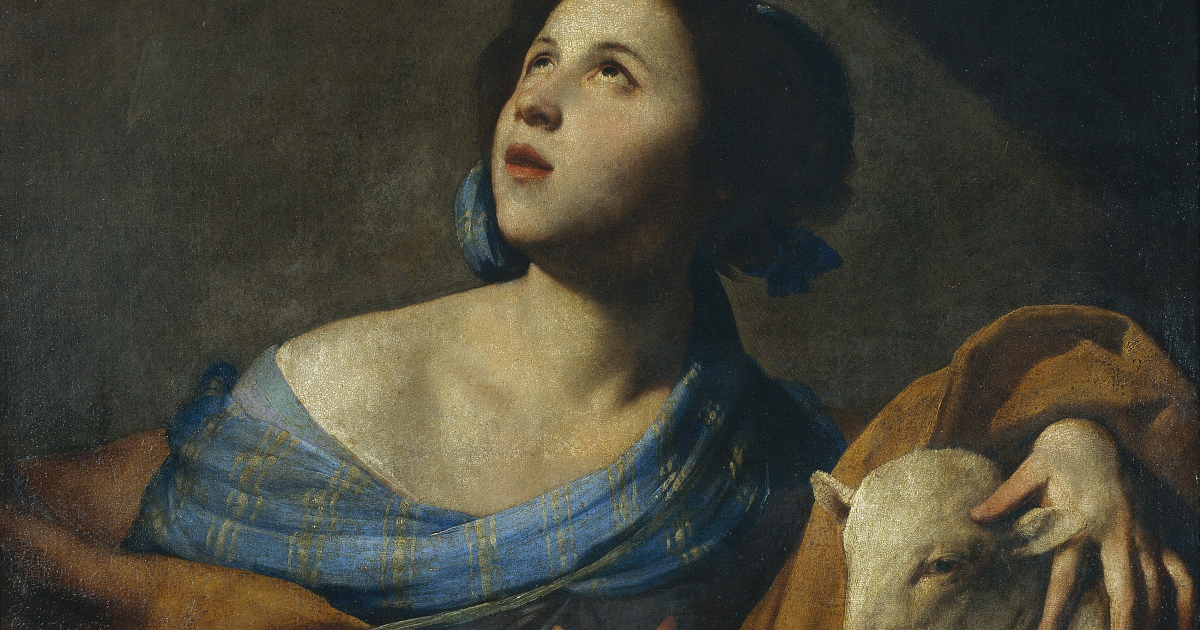


If you’re in Rome on 21 January, there’s really only one place to be. It’s the feast of St Agnes, and this year, as every year, there is the blessing of the lambs at her church, St Agnes Outside the Walls, at 10.30 am. My daughter is an Agnes, so a couple of years ago, when the feast fell on a Sunday, I took her to the church to celebrate her saint. My friend lived nearby and came with us.
It’s a parish church in what is now a Roman suburb, and the place was packed, standing room only for us. At the front, children were sitting cross-legged on mats in front of the altar. But before the Mass started, the focus of attention was at the back of the church, where two dear little lambs were each tucked up in a box under a white satin coverlet with the initials S.A.V. (Saint Agnes, Virgin) and surrounded by roses, white for one, red for the other, with satin-covered handles. Naturally, everyone congregated to admire them, especially the children. Only their faces peeped out. There was the occasional faint bleat, but on the whole the creatures were wonderfully quiet, so quiet indeed that we suspected they had been slipped something to make sure they behaved.
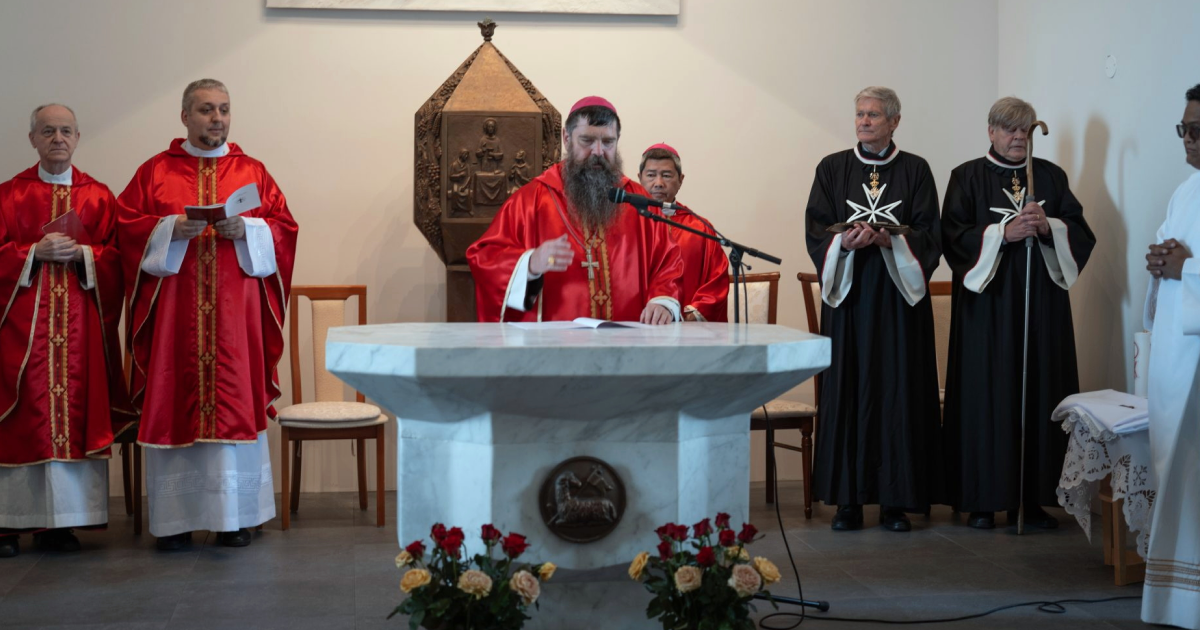
At the beginning of the Mass, they were brought down the steps into the church behind the celebrant, the Abbot General of the Canons Regular of the Lateran, who stroked their heads before the containers were carried slowly inside. The bearers of the wooden pallet included a couple of Indian nuns and, at the back, a young girl. He blessed them on the altar. Then they were taken off. We knew that they were destined to provide the wool for the white pallium, a near-circular band with black crosses that the Pope presents to archbishops to represent their unity with him. After that, one can only hope the creatures would be spared the fate of other lambs.
For the name Agnes is that of a lamb, and the legend is that she was martyred when she was only 13 years old after she refused to marry the son of the emperor’s prefect because she was wedded to Christ. A lamb, then, seems a good symbol of her youth and innocence. In his sermon, the Abbot General greeted all the Agneses on their feast day.
Within the church, Agnes appears on the seventh-century mosaic in the apse as a Roman empress, young but crowned with gold, flanked by two popes, one of them Honorius, who built the present basilica over the site of the fourth-century church, which itself was built over the remains of the young martyr. After Mass, everyone took it in turns to troop down the narrow steps into the dark little space where her tomb is. There’s a kind of window behind which can be seen the inscription to the virgin and martyr. This is the heart of the church, and we stood for a few minutes in silence before making way for the next pilgrims coming down.
If you make it to the church, don’t forget the neighbouring building, a fourth-century mausoleum once attached to a basilica, now no longer used for worship, dedicated to Saint Constanza, the daughter of the emperor Constantine, though she was never properly canonised. In the fourteenth-century Golden Legend, a compendium of saints’ lives, we read in the life of Agnes that “Constance the daughter of Constantine was smitten with a sore and foul leprosy. When she had heard of the vision of S. Agnes, at her tomb showed to her friends, she came to the sepulchre of S. Agnes, and when she was in her prayers she fell asleep, and she saw in her sleep S. Agnes saying to her: Constance, work constantly, and if thou wilt believe in Christ, thou shalt anon be delivered of thy sickness, wherewith she awoke and found herself perfectly whole, and anon she received baptism, and founded a church upon the body of the virgin and there abode in her virginity, and assembled there many virgins, because of her good example.”
It has the loveliest fourth-century mosaics in the ceiling, notably an early representation of Christ as shepherd, flanked by palms and by two followers, with little sheep, or lambs, at his feet. For a follower of St Agnes, it seems just right.