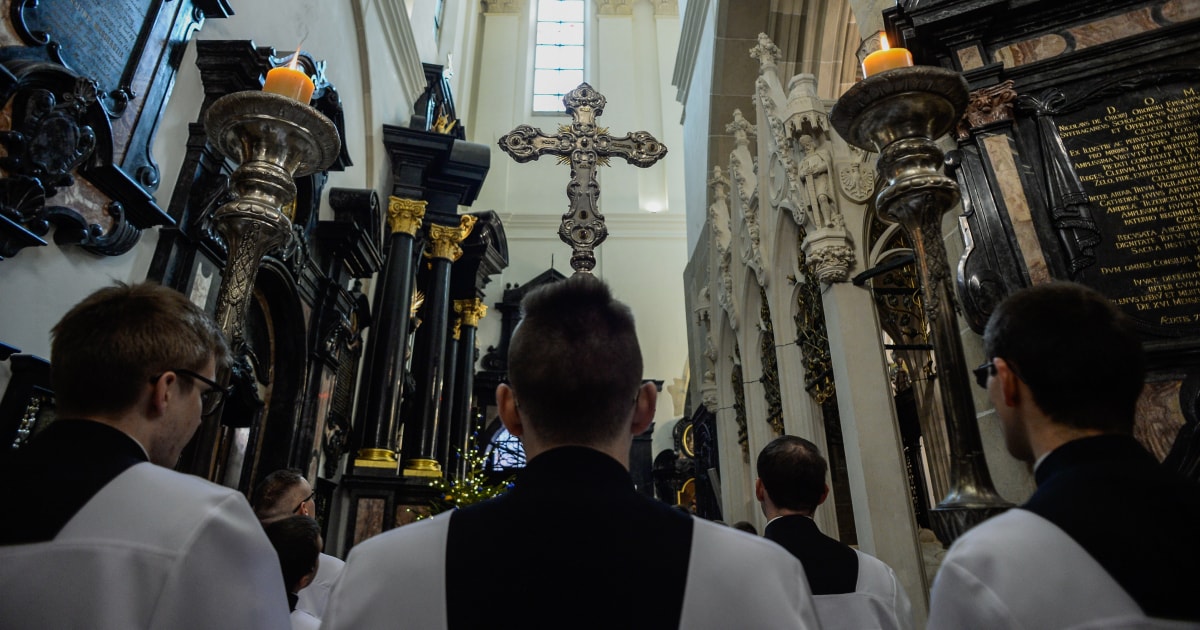


In the past several months, I have heard countless encouraging stories about Americans discovering or returning to the Catholic Faith.
I have heard of formerly hostile Capitol Hill staffers secretly joining Catholic colleagues for daily Mass. At least one of these staffers will be welcomed into the Catholic Church at Easter. A formerly agnostic acquaintance told me that my friends and I sparked his conversion. A friend going through a dark time returned to the sacraments and daily Mass. Another friend is studying the Faith for the first time so that she can catechise her ‘cafeteria’ Catholic parents. Yet another recounted how a Christian colleague was recently upset to learn that his mentor was becoming Catholic.
Wednesday night adoration at my local parish – which previously drew about a dozen older parishioners and a few young people – has transformed into near-standing-room-only events. Each week, the pews are overrun with young people who eagerly listen to our parochial vicar’s meditations before the Blessed Sacrament. The confession line during these events and after daily Mass is consistently so long that I have begun confessing the sin of anger at the waiting times – eliciting chuckles from our endlessly patient priests.
Friends across the country have noticed similar trends. It thus comes as little surprise that, according to The New York Times, this Easter the Catholic Church will welcome record numbers of converts at parishes across America.
One key factor undoubtedly driving this trend is the increased accessibility of information about the Faith, which is enabling Americans to encounter the truth that only the Catholic Church offers. Similarly, anecdotes repeatedly emphasise the power of human connections and relationships, which have played a pivotal role in planting seeds of curiosity, questions and ultimately acceptance of the Catholic Faith.
According to The New York Times, the Archdiocese of Detroit, the Archdiocese of Washington and the Archdiocese of Galveston-Houston are welcoming their highest numbers of new Catholics in 21, 15 and 15 years respectively. The National Catholic Register similarly reports that the Archdiocese of Oklahoma is ‘expecting a 57 per cent increase in unbaptised people becoming Catholics at Easter – from 635 in 2025 to nearly 1,000 in 2026’. Even Los Angeles has reportedly seen a 143 per cent increase in Catholic converts since 2023. Both the Times and the Register acknowledge that dioceses across the country are witnessing similarly impressive trends.
The Times mentioned several reasons why respondents are embracing the Catholic Faith, including ‘the desire for community, social and political instability, outreach to young people and technological change’. Others have highlighted the Catholic Church’s powerful history and tradition, its unbroken lineage tracing directly to Jesus Christ and His appointment of St Peter as first pope, and the Church’s unchanging doctrine, which exposes the weakness of other religious sects – especially as they embrace woke politics and lose adherents in the process.
In my personal experience, it seems that many of those returning to the Faith or accepting it for the first time were already hungry for meaning and something ‘more’ in their lives – and became curious about Catholicism because of the authentic Catholic witness around them. I think of my friend, who began working in an office that was overtly anti-Catholic. Over time, several of her coworkers-turned-friends began asking to join her at daily Mass and even asking for marriage advice. This Easter, my friend is sponsoring one of those coworkers as she enters the Catholic Church.
I have also witnessed the increased passion and curiosity about the Faith at the weekly meditations in my parish. Each time, it is evident that my parochial vicar’s talks on relationships, courage, cultivating a strong prayer life, living joyfully and more are having a profound impact on the young people present. ‘I want everyone seated here to bring a friend next week,’ he will occasionally say. People do.
A friend of mine who was never catechised properly has been going almost weekly, and bringing her more secular friends. She has recently begun asking questions about the proper reception of Holy Communion, and what spiritual reading to suggest to her friends.
Once the talk is over, the massive group heads to the local pub for beers and snacks, where conversations naturally flow from faith to friendship. Similar events across the country, such as Kate DePetro’s Pizza to Pews event in Manhattan, are drawing hundreds of young Catholics to community and Mass.
These types of events show how the witness of faithful Catholics is playing a critical role in the surge of conversions happening around America.
The truth about the Catholic Faith has always remained the same. What is new is the accessibility of discovering it – thanks to the internet, those hungry for knowledge have never had an easier time accessing information with just a few clicks. Once they begin their journey, they have a wealth of knowledge at their disposal: papal encyclicals, the Catechism of the Catholic Church, Church history, podcasts, talks and shows, and so much more.
The internet has also enabled countless young Catholics to discover the truths of the Faith that previous generations were expected to absorb almost solely from CCD classes or weekly Mass. This religious formation – already insufficient for the average person – was especially bleak in dioceses with lukewarm or poor priests. I have heard stories from Generation X Catholics about how difficult it was to discern authentic Catholicism in an age when so many Catholic clergy and theologians sought to redefine the Faith along left-wing social justice lines. The merits of the sacraments were lost while the significance of the True Presence of the Eucharist was downplayed.
Thanks to the internet, however, younger generations have the truth right at their fingertips. What is more, Americans are increasingly curious – which is perhaps why Fr Mike Schmitz’s ‘The Bible in a Year’ is consistently ranked No 1 among religion and spirituality podcasts. It is also perhaps why the Catholic prayer app Hallow has been installed almost 24 million times across the world.
Anyone who earnestly investigates the Catholic Church can come to only one conclusion. The key is simply whether they begin looking. And from what I have witnessed, the impetus for investigation often comes from disbelief that Catholic colleagues, friends, acquaintances, media personalities and others are ‘the real deal’. They are drawn to the joy and kindness of successful, virtuous people and want to become like them.
I know this is true because two friends just like this inspired me to throw myself fully into my faith after my first year of college. I am consistently amazed at the way their kindness and loving friendship has softened progressives and agnostics whom I initially wrote off, but whom I have seen quite literally baffled as they wonder what to make of the pair.
Conversely, the loudest voices touting Catholicism are often those who weaponise the Catholic Faith for personal or political purposes – all while living lives antithetical to the Faith. By watering down the Faith or engaging in nasty bickering, they do a major disservice to the faithful Catholics nationwide who are bringing people in through their authentic witness.
Thankfully, most Americans are not chronically online. Instead, they will encounter the Faith through the friends, neighbours and acquaintances they meet in daily life. Already, this seems to be fostering a powerful wave of enthusiastic converts that I hope will last well beyond the Easter season.